Chem Film (Chemical Conversion Coating) Explained
If you have ever received a drawing that calls for “chem film” on one page, “chemical conversion coating” on another, and “Alodine” in the notes, you are not looking at three different processes. You are looking at one process with a naming problem.
At Certified Metal Finishing, our team has over 100 years of combined experience applying chemical conversion coatings to aluminum for aerospace, defense, and industrial customers. The confusion around names is one of the most common things we clear up with engineers and buyers, so let’s start there.
What is Chem Film?
Chem film is a chemical conversion coating for aluminum. A chemical reaction between the aluminum surface and a chromate based solution converts the outer layer of the metal into a thin, protective, electrically conductive film. It is governed in the United States primarily by MIL-DTL-5541, and it is not the same thing as anodizing.
The terms below all describe this same process:
- Chem film (also written chemfilm or chem-film)
- Chemical conversion coating
- Chromate conversion coating
- Iridite
- Alodine
Alodine and Iridite are brand names, not processes
This is the point worth pausing on. Alodine is a registered trade name for a family of conversion coating chemistries, originally from Amchem Products and now owned by Henkel, which markets the line under its Bonderite brand. Iridite is a trade name owned by MacDermid. Both are proprietary chemistries that produce a chemical conversion coating. Neither is a specification.
In practice, “Alodine” has become a generic verb on many shop floors and drawings, the way “Kleenex” is used for tissue. That’s fine in conversation. On a drawing, it is a problem. A callout that says only “Alodine” does not tell your finisher which type, which class, or which specification you need, and it technically restricts the process to one supplier’s chemistry when what you almost certainly care about is the performance. The correct callout is the specification: MIL-DTL-5541, with the type and class.
Chem Film Is Not Anodizing
Both processes treat aluminum, both improve corrosion resistance, and both are frequently listed on the same drawing, so they get confused. The differences matter.
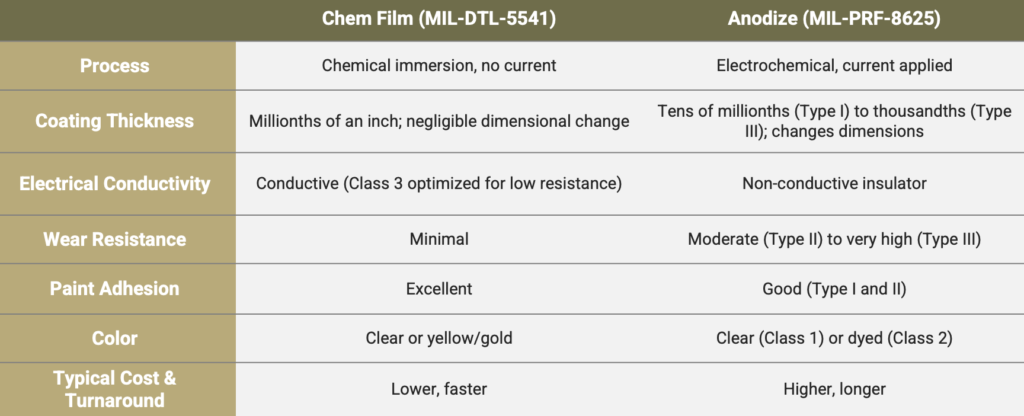
Anodizing is electrochemical. The part is submerged in an electrolyte and current is applied, growing a hard, non conductive aluminum oxide layer that penetrates into the metal and builds up on the surface. Coating thickness ranges from tens of millionths of an inch for Type I chromic anodize to a few thousandths for Type III hardcoat, and it changes part dimensions.
Chem film is purely chemical. No electrical current is used. The part is immersed in (or in some cases sprayed or brushed with) a conversion coating solution, and the reaction happens on its own. The resulting film is extremely thin, typically measured in millionths of an inch, and for practical engineering purposes it does not change part dimensions.
That leads to the three properties that make chem film the right choice in the situations where it is chosen:
- It is electrically conductive. Anodize is an insulator. If a housing needs to ground, bond, or carry a shield connection, chem film is the coating that lets it.
- It has negligible dimensional impact. Precision fits, threads, and tight tolerance features can be coated without machining compensation.
- It is an excellent paint base. Chem film is one of the most common pretreatments under primer on aerospace aluminum structure.
The trade off is durability. Chem film is a thin, relatively soft film. It offers good corrosion protection for its thickness, but it does not provide wear resistance, and it is not a substitute for anodize where abrasion, sliding contact, or a hard surface is required. For more on the anodizing side, see our article on the types of anodizing.
What MIL-DTL-5541 Specifies
MIL-DTL-5541 is the U.S. military detail specification for chemical conversion coatings on aluminum and aluminum alloys. Many drawings still reference the older designation MIL-C-5541. The two refer to the same process lineage, and if your drawing calls out either one, the conversation with your finisher is the same. The related SAE specification is AMS 2473 for general purpose chemical film treatment.
The specification defines the coating by two dimensions: type and class.
Type I
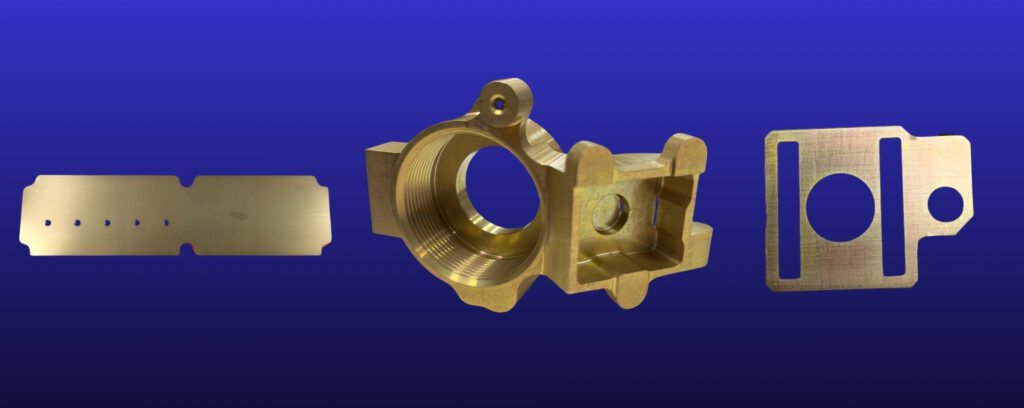
Compositions containing hexavalent chromium. The traditional chemistry, and the one most people picture when they say “Alodine” or “gold chem film.”
Type II
Compositions containing no hexavalent chromium. Typically trivalent chromium based. Developed in response to environmental and worker safety regulation of hexavalent chromium, and the choice when RoHS or similar compliance is required.
Type I and Type II both meet the same performance requirements of the specification. The difference is the chemistry used to get there, not the corrosion protection the part receives. If your program has a RoHS, REACH, or hexavalent chromium restriction, specify Type II. If not, either is acceptable and Type I remains widely used in legacy aerospace and defense drawings.
Class 1A vs. Class 3: The Performance Target
Class 1A
Maximum corrosion protection. The heavier coating, used for parts that will be painted or left unpainted where corrosion resistance is the primary goal.
Class 3
Corrosion protection where low electrical contact resistance is required. A lighter coating that trades some corrosion resistance for conductivity. Specified for grounding surfaces, EMI and RFI shielding contact areas, and electrical bonding.
A complete drawing callout therefore looks like this: Chemical conversion coat per MIL-DTL-5541, Type II, Class 3. That one line tells the finisher the specification, the chemistry, and the performance target, and it leaves nothing to interpretation.
Clear vs. Yellow: What the Color Tells You
Chem film is commonly available in two appearances, and the color is a byproduct of the chemistry and coating weight, not a separate specification.
Yellow (gold, tan, iridescent). The traditional look of Type I hexavalent chromate coatings, especially at Class 1A coating weights. The color is a reasonable visual indicator that a coating is present and is often preferred for that reason on unpainted parts.
Clear (colorless to faintly iridescent). Typical of Class 3 coatings and of most Type II trivalent chemistries. Preferred where appearance matters, where the part will be painted, or where a clear finish is called out.
Two cautions. First, color is not a reliable measure of coating quality or class; a clear coating can fully meet the specification. Second, the base alloy affects appearance. Alloys with higher copper content, including many 2xxx and 7xxx series alloys, tend to produce darker or less uniform color than 6061 or 5052. If a consistent appearance across a batch matters, tell your finisher the alloy and the appearance requirement up front.
When to Specify Chem Film?
Chem film is the right choice when one or more of the following is true:
- The part must remain electrically conductive for grounding, bonding, or shielding.
- The part will be painted or primed, and you need a corrosion resistant adhesion base under the paint.
- Dimensional change is not acceptable, and a coating measured in millionths of an inch is the only option.
- Corrosion protection is required, but the part does not see wear, abrasion, or sliding contact.
- Cost and turnaround matter, and the more economical process meets the requirement. Chem film is generally faster and less expensive than anodize.
- An anodized part has been machined, drilled, or reworked after anodizing, and the exposed bare aluminum needs protection. Chem film is the standard touch up treatment for these areas, and MIL-DTL-5541 permits brush application for that purpose.
Chem film is the wrong choice when the surface is a wear surface, when a hard or thick coating is required, or when electrical insulation is needed. In those cases, look at Type II or Type III anodize.
Chem Film vs. Anodize at a Glance
What to Put on Your Drawing
Getting the callout right before parts go on the floor is the single most effective thing you can do to avoid a rejected lot or a surprise conversation. We recommend the drawing include:
- The specification, type, and class: for example, MIL-DTL-5541, Type II, Class 3. Avoid a brand name alone.
- The base alloy and temper. Different alloys react differently, and the finisher needs this to process correctly.
- Any RoHS or hexavalent chromium restriction, which will drive Type II.
- Whether the part will be painted afterward, and whether any surfaces must be masked.
- Any electrical contact resistance requirement, which points to Class 3 and should be stated explicitly if it is a controlled characteristic.
- Appearance requirements, if consistent color across the lot matters.
Practical Notes from the Shop Floor
A few things that experienced buyers know and newer engineers often learn the hard way:
- Fresh chem film is soft and needs time to cure. Parts should be handled carefully immediately after processing, and the coating gains its full properties over roughly the first 24 hours.
- The coating must not be overheated during drying. MIL-DTL-5541 limits drying temperature, because excessive heat dehydrates the film and reduces its corrosion protection. If your downstream process involves heat, tell your finisher.
- Cleanliness before coating determines the result. Oils, oxides, and prior finishes must be fully removed. Parts that arrive with heavy machining residue or mixed finishes will be cleaned and deoxidized first, and that may affect appearance.
- Chem film is an aluminum process. Magnesium uses a different conversion coating and a different specification. Everything in this article applies to aluminum and aluminum alloys.
Who CMF is and Why This Matters
Certified Metal Finishing has been providing NADCAP accredited chemical processing in South Florida since 1982, serving aerospace, defense, and industrial manufacturing customers across the country. We process chemical conversion coatings to MIL-DTL-5541 Type I and Type II in all classes, MIL-C-5541, and AMS 2473, in both standard and RoHS compliant chemistries, in clear and yellow. We work directly with engineers and procurement teams on specifications before parts are machined.
If you have a question about a current job, a drawing callout, or whether chem film or anodize is the right choice for your application, our Planning Department is happy to help at +1 (954) 979-0707.
It is always easier to get the specification right before you process than to correct it after.