Anodizing Basics: Types of Anodizing and How to Choose
If you’ve worked with the different types of anodizing for years, you may already know more than you think. But if you’ve ever handed off a drawing and wondered exactly what was happening in the tank, or if you’ve been caught off guard when a supplier asked whether you needed Type II or Type III, this article is for you.
At Certified Metal Finishing, our team has over 100 years of combined experience in providing anodizing services for aerospace and industrial manufacturing.
The questions we get most often aren’t about obscure cases. They’re about fundamentals: What are the types of anodizing? What does MIL-PRF-8625 actually require? When does the difference between processes materially affect your part?
Let’s start from the beginning.
Anodizing Is NOT Plating
This is the single most important thing to understand, and it’s where a lot of miscommunication starts.
Anodizing is an electrochemical process that converts the surface of aluminum into a hard, protective aluminum oxide layer. The coating grows from the metal itself, penetrating inward into the base material as well as outward as build-up. You are not adding a foreign material. You are transforming what’s already there.
Plating works the opposite way. When you plate a metal, you’re depositing a foreign material onto the surface. The coating sits on top, 100% as external build-up.
That difference has real consequences for part engineering.
For example: A hardcoat anodize at 0.002 inches thick (0.001 build up and 0.001 penetration) adds 0.002 inches to the diameter of a shaft. Plating to the same total thickness would add 0.004.
If you’re engineering to anodizing tolerances using plating assumptions, you’ll have problems.
The anodizing process begins when the part is submerged in an electrolyte bath and electrical current is applied. This drives a controlled reaction between the aluminum and the electrolyte, forming a hard, non-conductive oxide layer that becomes an integral part of the metal. The result is a surface that is more corrosion-resistant, non conductive, more wear-resistant, and in most cases better suited to the application than the base aluminum alone.
One important boundary: anodizing is an aluminum process. It does not work on steel, titanium, or most non-aluminum alloys. Everything in this article applies to aluminum.
The Types of Anodizing: What MIL-A-8625 Specifies
In the U.S., anodizing types for aerospace, defense, and industrial manufacturing are governed primarily by AMS specs and MIL-PRF-8625, the military specification that defines anodic coatings for aluminum and aluminum alloys. Many engineers still reference MIL-A-8625F, the most recent revision under the original designation. Note that this specification has also been issued under the updated designation MIL-PRF-8625 in some procurement contexts. If your drawings call out either, the underlying process types are the same.
MIL-PRF-8625 defines four main anodizing types. Here’s what each one means in practice.
Type I: Chromic Acid Anodize (CAA)
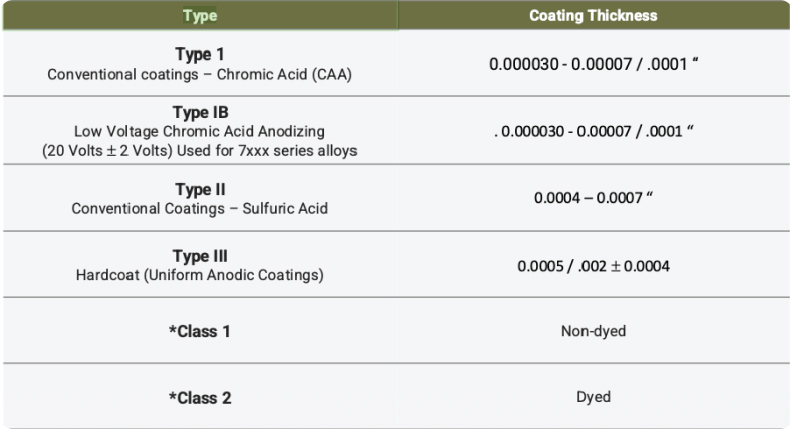
Type I anodizing uses chromic acid to produce the thinnest coatings of any anodizing process, typically between 0.000030-0.00007/0.0001 inches.
Because the coating is so thin, Type I has minimal dimensional impact. It’s frequently specified for close-tolerance components where even small changes to part dimensions are not acceptable, and for parts that will be bonded or painted, because the thin coating provides excellent adhesion for primers and sealants.
Type I is also historically preferred for fatigue-sensitive parts. The thinner coating preserves more of the base metal’s mechanical properties than heavier processes, making it valuable in structural aerospace applications where cyclic loading is a concern.
One important context: Type I uses chromic acid, which is a regulated hazardous material. The environmental and health compliance costs associated with chromic acid have made Type I processing less common than it once was. That’s where Type IB comes in.
Type IB: Low Voltage Chromic Acid Anodize
Type IB is a chromic acid process run at lower voltage (20 volts plus or minus 2 volts), developed specifically for 7xxx series aluminum alloys.
Coating thickness is comparable to Type I, in the same range of 0.000030-0.00007/0.0001 inches. The 7xxx series alloys, which use zinc as the primary alloying element, are common in aerospace structural applications (7075 is the most
familiar example) and can be sensitive to standard chromic acid processing conditions. If your drawing calls out a 7xxx alloy and requires chromic acid anodize, Type IB is the correct conversation to have with your finisher.
Type II: Sulfuric Acid Anodize
Type II anodizing uses sulfuric acid as the electrolyte and produces coatings in the range of 0.0004 to 0.0007 inches. It’s the most common anodizing process across commercial and industrial applications.
Unlike Type I, Type II produces a thicker, more porous coating that accepts dye readily. This is why anodized aluminum consumer products, architectural elements, and commercial hardware come in a wide range of colors. The dye enters the pores of the coating before sealing.
Under MIL-PRF-8625, Type II coatings are designated as either:
- Class 1: Non-dyed (clear or natural color from the alloy)
- Class 2: Dyed to a specified color
For structural and functional aerospace applications, Class 1 is the default unless color coding or identification requirements dictate otherwise.
Type II is the right choice when you need reliable corrosion protection, good adhesion for paint or primer, and moderate wear resistance, without the dimensional impact of a heavier coating. It’s more economical than Type III and appropriate for the majority of general-purpose aerospace hardware that doesn’t see extreme wear or abrasion.
Type III: Hardcoat Anodize
Type III hardcoat anodizing produces coatings in the range of 0.0005/0.002 inches, with coating thickness controllable to plus or minus 0.0002 inches. It is significantly harder than Type II, routinely in the range of 60 to 70 on the Rockwell C scale.
That puts hardcoat anodize in the same hardness range as hardened tool steel, which is why it’s the specification of choice for aerospace and defense components subject to abrasive wear, sliding contact, or repeated mechanical stress.
The same Class 1 (non-dyed) and Class 2 (dyed) designations apply to Type III. For functional aerospace parts, Class 1 is nearly universal. Class 2 hardcoat is occasionally specified in defense applications where color coding aids part identification.
The trade-off for that performance is dimensional impact. Because hardcoat produces a thicker coating on every exposed surface, the effect on part geometry is substantially greater than Type II. Threaded components, internal bores, blind holes, and precision fits all require dimensional compensation before machining. We cover all of that in the second article in this series.
Type II vs. Type III Anodizing: When to Use Each
This is the most common question we field. Here’s a practical decision framework.
Use Type II sulfuric acid anodize when:
- The part needs corrosion protection and the surface needs to accept paint, primer, or bonding
- Dimensional impact needs to be minimized
- The application involves moderate environmental exposure without heavy mechanical wear
- Color or part identification are part of the requirement
Use Type III hardcoat anodize when:
- The component experiences abrasive wear, sliding contact, or mechanical impact in service
- Your drawing or program specification calls out Type III or hardcoat by name
- You need the coating to function as a wear surface, not just a protective layer
- Coating thickness consistency is a controlled characteristic on the drawing
- The part operates in harsh chemical, thermal, or abrasive environments
What type of anodizing is best for aerospace? The honest answer is: it depends on the component’s function. Structural parts with fatigue requirements often call for Type I. General hardware calls for Type II. Wear-prone components in landing gear, hydraulic systems, and mechanical assemblies typically call for Type III hardcoat. When in doubt, call your finisher before machining.
A Note on Classes
Both Type II and Type III coatings are produced in Class 1 (non-dyed) or Class 2 (dyed). The class designation specifies whether the pores of the anodic oxide are sealed clear or sealed after accepting a dye (colorant). It does not change the fundamental performance of the coating.
For structural aerospace components, Class 1 is almost universally specified. Class 2 coatings are common in commercial and consumer applications, and occasionally in defense where color coding aids part identification.
Worth noting: not all base alloys accept dye equally well. If color consistency across a batch matters, that conversation should happen with your finisher before the job goes on the floor.
The Alloy Variable
One thing that consistently surprises engineers newer to anodizing is how significantly the aluminum alloy affects the coating result.
Anodizing is a reaction with the aluminum itself. Different alloys have different compositions, and those differences affect how the coating forms, what color it produces, and how protective it is. We will share the specifics on alloys in upcoming articles. For now, here’s what you should know:
Always designate your alloy and, if possible, the temper, when submitting parts. Your processor will coat to the specifications you provide, so getting the alloy information is critical.
Who CMF Is and Why This Matters
Certified Metal Finishing has been providing NADCAP-certified anodizing services in South Florida since 1982, serving aerospace, defense, and industrial manufacturing clients across the country. We specialize in Type I, II, and III anodizing under MIL-PRF-8625 and work directly with engineers and procurement teams on specifications before parts are machined.
If you have a question about a current job, a drawing specification, or an application that isn’t clearly addressed here, our Planning Department is happy to answer your questions at +1 (954) 979-0707
It is always easier to get the specification right before you process than to correct it after.
Certified Metal Finishing, Inc. | NADCAP Certified | (954) 979-0707 | certifiedmetalfinishing.com